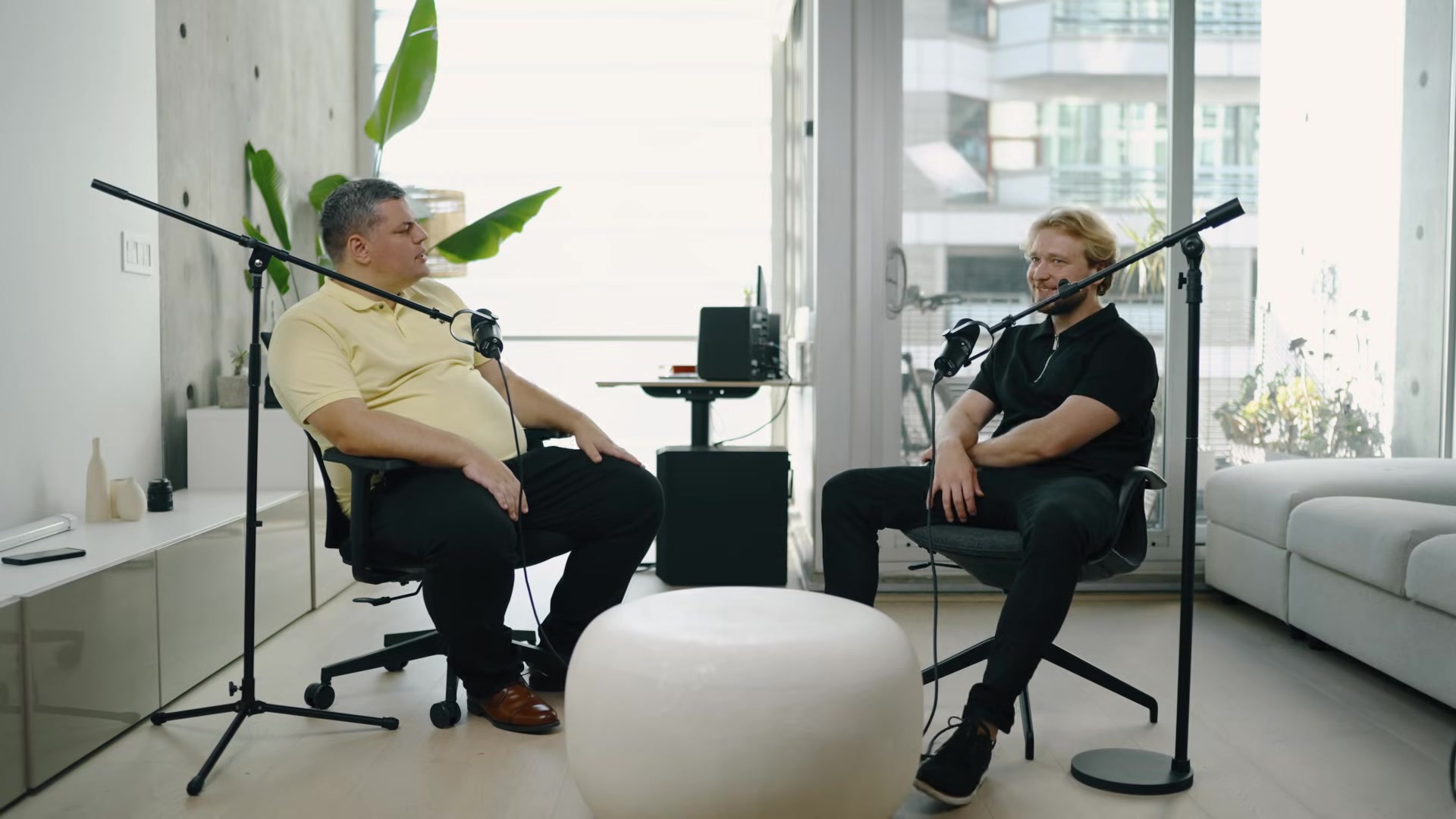
The Bay Signal is the interview show we produce in-house at FogLine Visuals, the San Francisco production studio that films video podcasts, launch videos and events for startups. For this episode our founder, Francisk Hanchar, sat down with Frank Sondors, co-founder and CEO of Salesforge, the cold email and AI sales agent platform. The conversation runs 88 minutes. We recorded it in the daytime corner of our studio at 855 Folsom St in SoMa, with three cameras, a broadcast microphone for each speaker and the light from the windows.
At a glance
- Show
- The Bay Signal, FogLine's in-house founder podcast (Built in the Fog series)
- Guest
- Frank Sondors, co-founder and CEO of Salesforge
- Host
- Francisk Hanchar, founder of FogLine Visuals
- Location
- FogLine Visuals studio, 855 Folsom St, SoMa, San Francisco
- Set
- daytime look, two black swivel chairs, a concrete column, tall plants and floor-to-ceiling windows
- Cameras
- three (a wide two-shot, a medium close-up on the guest, a medium close-up on the host)
- Sound
- Shure dynamic broadcast microphones on floor boom stands
- Lighting
- window daylight with soft fill on the faces
- Episode length
- 1 hour 28 minutes
- Delivered
- full episode, guest lower third, 40 chapters, custom thumbnail
Who Frank Sondors is
Frank runs Salesforge, a platform for outbound sales: cold email, LinkedIn outreach and AI agents that do the work of an SDR. The company sells it under a family of "forge" brands, including Salesforge, Mailforge, Leadsforge and an AI SDR called Agent Frank. In the episode he tells his own story like this:
- He grew up in Latvia and moved to the UK at 16, where he studied politics, international relations and security.
- He worked at the European Commission for a short time, then switched to tech.
- He started his tech career at Google and spent more than a decade in tech, mostly in sales and customer success roles. In his last job before Salesforge he was a VP of Sales running a team of 50.
- He started Salesforge about three and a half years ago. He found his two co-founders through Y Combinator's co-founder matching platform.
- He now lives in Vilnius and flies to more than 30 countries a year for events and customer meetings.
On the show Frank said Salesforge reached $3M in its first year, and that the pre-seed round of about half a million dollars it raised early on is still sitting in the bank, untouched. Today the company has about 50 people, more than 20 AI agents and around 10 agencies working for it. He said 60 to 70% of revenue comes from the US, and that Salesforge's technology runs under the hood of more than 20 of its competitors.
How he ended up on the show
The first question of the episode is "How did you find me?" Frank's answer: he emailed. That fits the rest of the conversation. When Frank comes to a city, he writes to his customers and his ideal customer profile there. He told us only about 1 in 20 people reply to a coffee invite, so instead he runs events: two to four of them during a five-week stay, for up to 100 people each. He fills a room with about a week of email and LinkedIn outreach and spends at most around five hours on each event.
What the conversation covers
The YouTube description has 40 chapters. These are the parts founders tend to come back to:
- Distribution vs product (33:11). Early on, distribution wins. But if the product is weak, churn catches up with you, and buyers now research tools on Reddit and with AI assistants before they talk to sales.
- Overfunded startups (37:16). Frank says he is waiting for companies that raised far more than they needed to run out of road. He gives them about five more years and expects many to end up as zombie companies sold for very little, while Salesforge stays "default alive".
- The moat when everyone has GTM agents (44:15). His answer is data: learning loops that make an agent better the more it is used.
- Agents first, agencies second, humans last (55:18). When a new job appears, he first looks for an AI agent that can do it, then for an agency or freelancer, and only then hires.
- Cold email or ads (1:00:45). He compares the cost per thousand impressions of cold email with paid social and explains when he runs a narrow "spearhead" campaign and when he casts a wide net.
- The four pillars of cold email (1:20:16): the list, the sending infrastructure, the copy and the orchestration. Right after that he tells the story of a customer whose emails all went to spam because of the phone number in his signature (1:21:48).
- Agents selling to agents (1:27:34). He expects that within about five years up to 20% of email traffic will be AI agents writing to other AI agents.
How we recorded it
Frank's episode was recorded in the same daytime corner of our studio where we filmed the episode with voice coach Juliana Andreeva, but set up differently. Instead of handheld microphones, both speakers had Shure dynamic broadcast mics on floor boom stands. That leaves the hands free and lets a guest lean back in the chair and talk for an hour and a half without holding anything.
Three cameras cover the room. The wide two-shot shows both speakers, the low white ottoman between them, the windows and the city outside. The two medium close-ups give the edit somewhere to go during long answers, and they crop cleanly to a vertical frame when we cut clips.
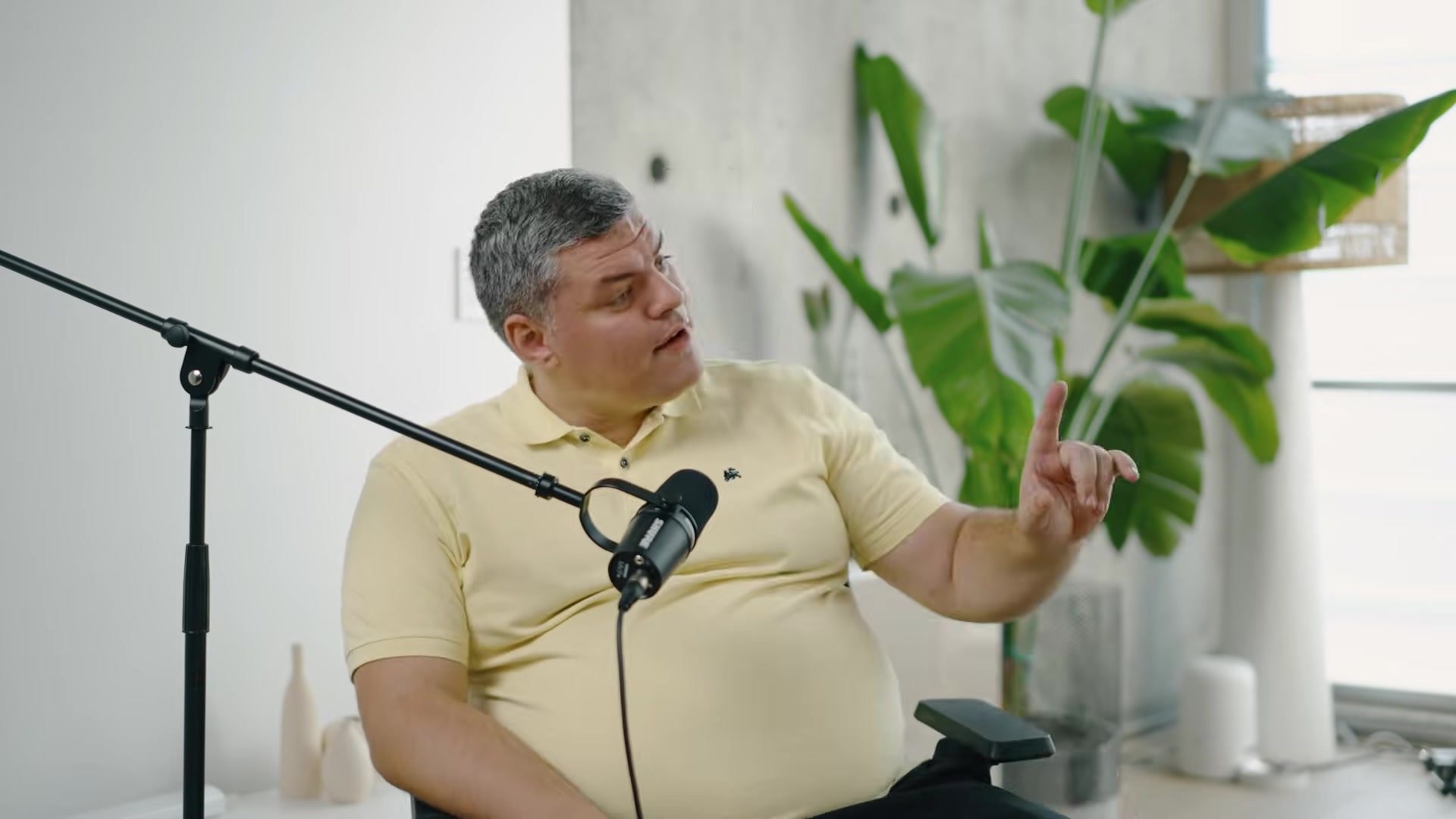
There is no cold open in this episode. It starts straight on the first question, because "How did you find me?" / "I just emailed you" works as a hook by itself. A lower third introduces Frank in the first seconds with three facts about Salesforge, so new viewers know who is talking before the first answer is over.
Making a 90-minute episode easy to use
Long conversations are where founders say the most interesting things, and also where viewers get lost. Three things help:
- Chapters. Forty timestamps let someone jump straight to cold email deliverability or to pricing without scrubbing.
- Several angles. Changing the shot with the conversation keeps people watching long answers.
- A clear first minute. A guest card and a strong first exchange tell new viewers in a few seconds who this is and why they should stay.
What this means for your company's podcast
- You don't need your own studio. Our studio at 855 Folsom St comes with the cameras, microphones and lights already set up, and the crew runs them.
- A guest who travels a lot is easier to book when the recording is simple for them: they walk in, sit down and talk.
- Plan the chapters and clips together with the episode. An hour of conversation with a founder like Frank is enough material for weeks of content.
FAQ
See how our video podcast production works, look around our studio at 855 Folsom St, request a custom quote for your show.
Francisk Hanchar
Founder, FogLine Visuals
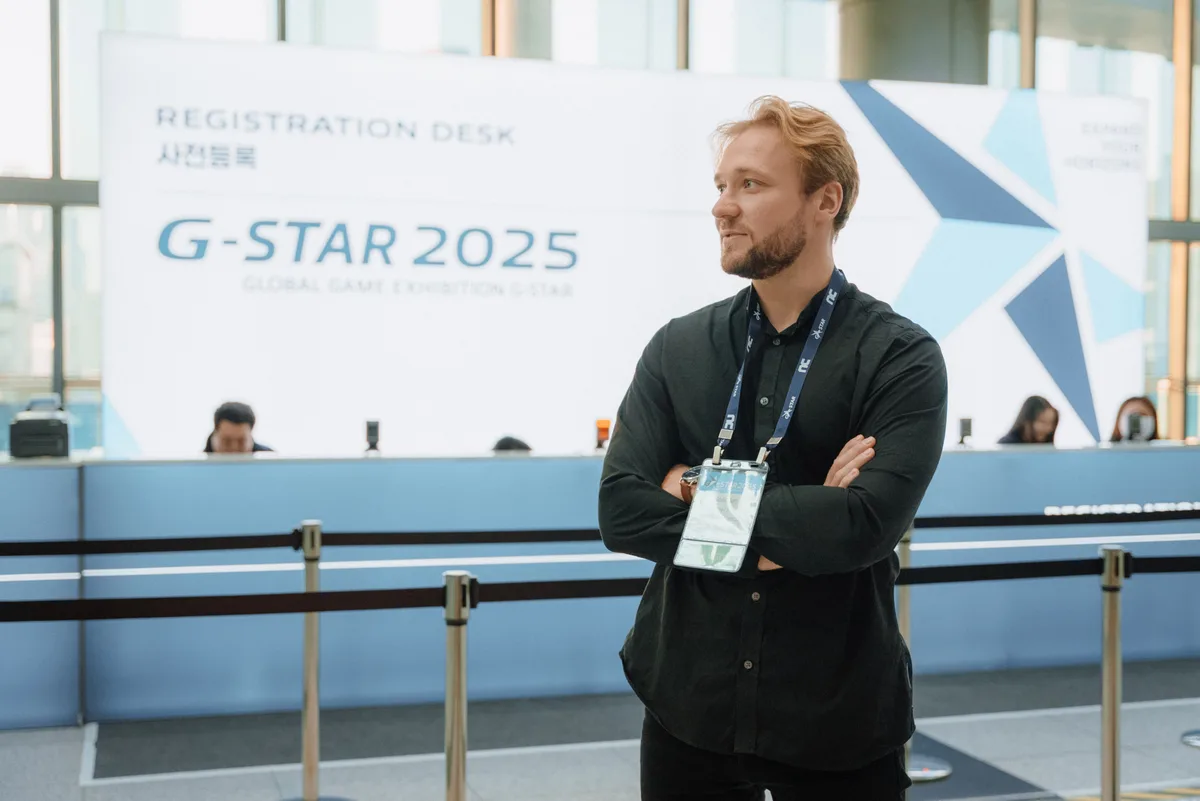
Francisk Hanchar is the founder of FogLine Visuals, a video production company in San Francisco. He produces video podcasts, launch videos and event coverage for startups, and hosts The Bay Signal.
About FogLine