At a glance
- Client
- Archetype AI, a physical AI company founded by former Google ATAP researchers
- On camera
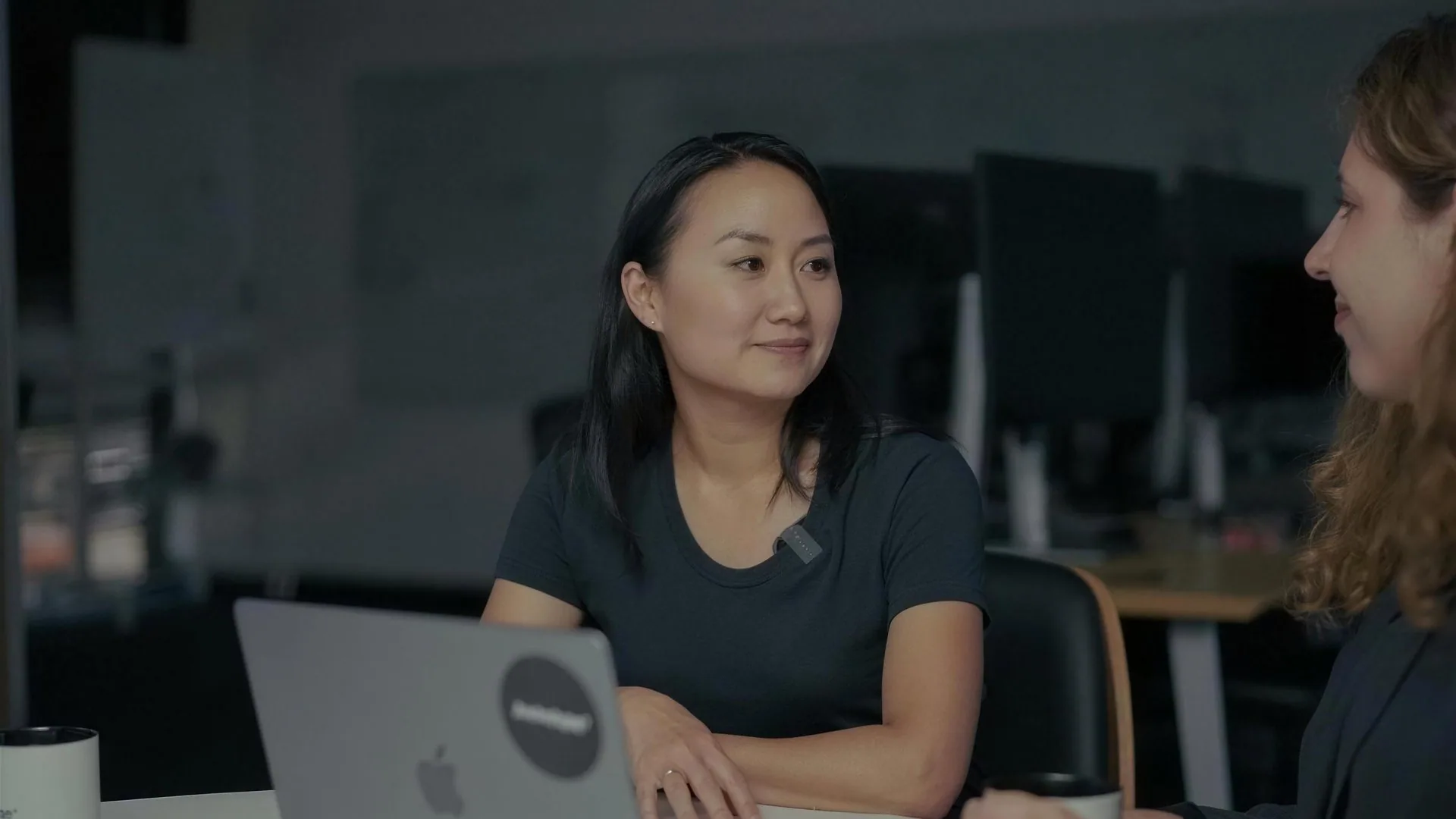
- Jaime Lien, co-founder and Chief Scientist, with a colleague
- What it supported
- the release of Archetype's Adaptive World Models paper (May 2026)
- Format
- a 12-minute explainer, recorded as a conversation
- Where we filmed
- Archetype's office, set up as a studio for the day
- What we delivered
- the edited explainer with on-screen text and graphics
- Where it lives
- next to the paper on Archetype's website and YouTube channel

Most launch videos are a founder talking for a minute. That works when you ship a feature. It works less well when the thing you're putting out is a new idea that people need to understand before they care about it. Archetype's launch was the second kind.
The company
Archetype AI builds physical AI: models that understand the physical world through sensor data rather than text or pixels. Its founders came from Google's ATAP group, where they worked on projects like the Soli radar. The company has raised $48M, including a $35M Series A in late 2025 led by IAG Capital Partners and Hitachi Ventures.
The brief: explain the research, not just announce it
In May 2026, Archetype published a paper on Adaptive World Models. The idea is that each machine learns its own behavior directly from its sensor data, on top of a general foundation model, instead of needing a separate model trained for every asset. The team didn't want another short announcement. They wanted a longer video where their researchers walk through the idea properly, for engineers and operations leaders who want the details.
That changed the plan from the start. A one-minute launch video is built around one hook and one message. A 12-minute explainer has to hold attention through the parts that are genuinely hard, so the structure matters more than any single shot.
Turning the office into a set
Archetype invited us to film at their office. Offices are built for work, not for cameras, so we rearranged the space, set up two softboxes to shape both the room and the faces, and put the cameras on tripods for a calm, steady look. Sound got the most attention: a 12-minute conversation can't have a rough stretch in the middle, so we set up the audio to stay clean from the first minute to the last. It looks like a set, but it's still their office, which suits a company that wants to come across as a research lab.
Shooting a long explainer as a conversation
Jaime Lien walks through the approach at a table with a colleague. We shaped it as a conversation rather than a lecture, because two people talking an idea through is easier to follow than one person presenting it. We recorded in sections, so each part could be tightened in the edit without breaking the flow.
The edit
We cut the sections together, kept the pace moving and added on-screen text and graphics for the key ideas. Someone watching without sound, or skimming on a phone, can still follow the main points.
Where it lives
The explainer sits next to the paper on Archetype's site and on their YouTube channel. For anyone who doesn't want to read a PDF, it's now the easiest way into the research. It's also the kind of video a sales or partnerships team can send after a first call.
When a long explainer beats a one-minute launch video
- You're launching an idea or a research result, not a single feature
- Your buyers are technical and want depth before they take a meeting
- Sales and partnerships need something to send after the first call
- You still want short clips for social, and the same shoot can provide them
Questions founders ask about explainer videos
Part of our launch video work → see all launch videos we've made. Planning a launch? Tell us about it.
More launches
Francisk Hanchar
Founder, FogLine Visuals
Francisk Hanchar is the founder of FogLine Visuals, a video production company in San Francisco. He produces video podcasts, launch videos and event coverage for startups, and hosts The Bay Signal.
About FogLine